
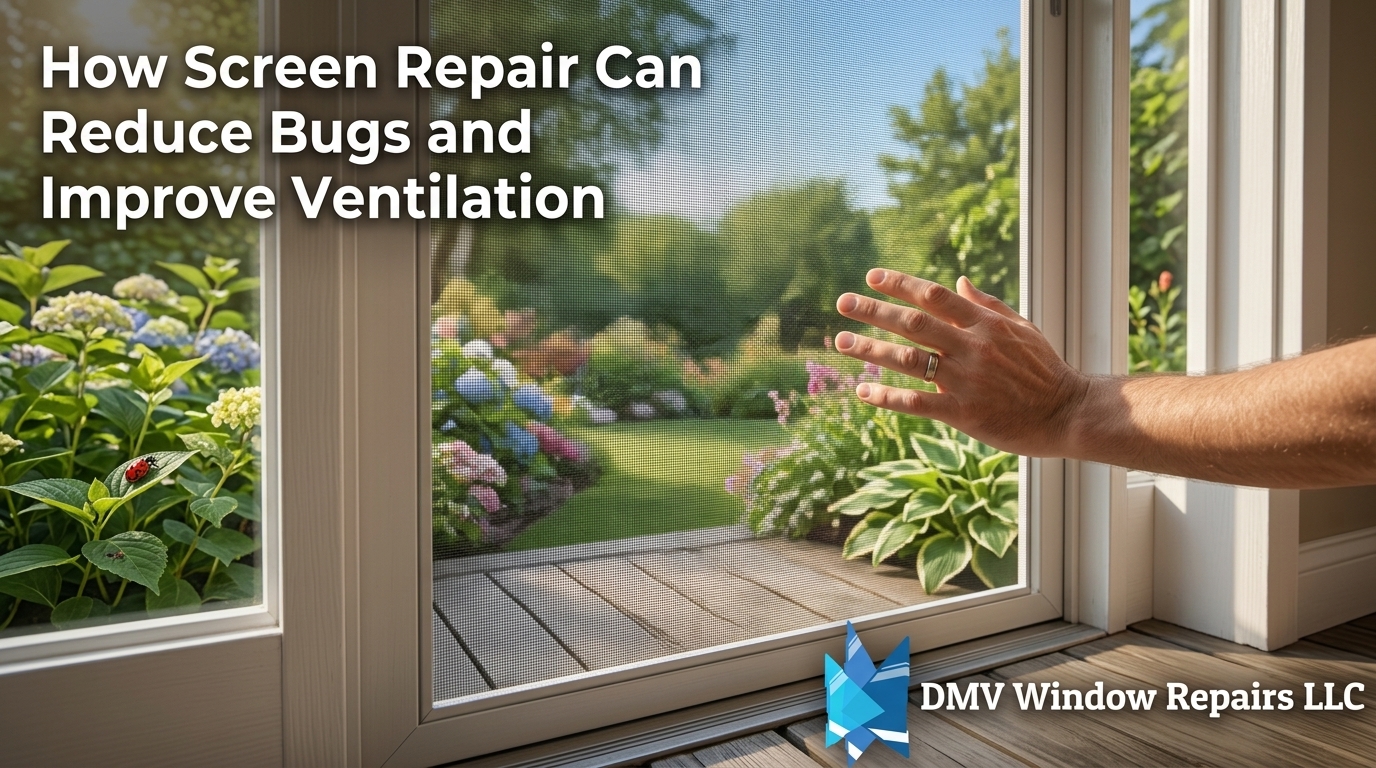
Proper screen repair eliminates every tiny gap, tear, loose edge, sagging section, and frame misalignment that currently allows insects to invade your home while simultaneously restoring full, unrestricted natural airflow through open windows and doors. Damaged screens fail in two critical ways: they create direct pathways for mosquitoes, flies, ants, spiders, no-see-ums, and other pests to enter freely, while their distorted mesh and poor fit block or divert incoming breezes so ventilation becomes weak, uneven, and ineffective.
Professional repair re-tensions mesh to factory-correct levels, squares warped frames, seals all perimeters tightly, cleans hidden debris from channels, and ensures perfect flush seating against window sashes—closing bug entry points completely while permitting strong, laminar cross-breezes that cool rooms naturally and flush humidity and stale air outdoors. Homeowners immediately experience fewer nighttime insect disturbances, reduced allergy symptoms from pollen and dust infiltration, noticeably cooler indoor temperatures during mild weather, lower air-conditioning runtime, and fresher, healthier indoor air overall.
These combined improvements make opening windows enjoyable and practical again instead of stressful or pointless. In regions with high humidity, seasonal pollen, and active insect populations, repaired screens deliver especially dramatic comfort gains. Investing in quality professional screen repair provides one of the simplest, most cost-effective ways to enhance both pest protection and natural ventilation at the same time.

How Damaged Screens Create Insect Highways
Even the smallest tear or puncture in window or door screen mesh becomes an open invitation for insects—mosquitoes need less than 1 mm to squeeze through, while ants, fruit flies, and tiny gnats exploit any gap wider than a pinhead. Pet claws, falling branches, wind-blown debris, or accidental impacts cause these breaches to appear and enlarge gradually. Once mesh integrity fails at any point, determined pests find and use the opening repeatedly—often within hours of damage occurring.
Sagging or loose sections pull away from the frame edges, forming permanent channels where crawling insects (ants, spiders, cockroaches) travel undetected underneath the mesh. Warped or corroded frames prevent flush contact with window sashes, leaving hairline cracks that widen with seasonal temperature changes and become reliable entry tunnels. Professional repair removes all damaged mesh entirely, cleans frames to bare condition, installs new high-quality material under precise tension, and ensures zero-tolerance perimeter sealing—eliminating every known and hidden bug pathway at once.
Common Insect Entry Points After Screen Damage
Small punctures from branches, toys, or tools enlarge quickly under wind pressure or repeated contact. Pet scratching concentrates damage at lower sections where animals paw repeatedly—creating irregular clusters of holes near the bottom rail. Corner separations from repeated removal/installation open diagonal gaps at frame joints that insects exploit immediately. Loose spline allows mesh to lift away from grooves, forming hidden tunnels along all four sides. Bent or corroded frames pull mesh unevenly, creating permanent perimeter gaps that no amount of pushing or taping can close effectively. Each defect multiplies bug entry exponentially during peak seasons—spring hatching, summer swarms, and fall migrations.
Why Tiny Gaps Matter More Than Most Homeowners Realize
A single 2 mm hole can allow hundreds of mosquitoes or no-see-ums to enter nightly during warm months. Ant trails discover even microscopic edge separations and follow them indoors within days. Spiders use loose corners to build webs inside window casings. Wasps seek sheltered gaps to start nests. Professional repair closes these vulnerabilities with taut mesh and flush fit, restoring the screen’s original role as a complete physical barrier without reducing ventilation.
How Proper Repair Restores Full Ventilation Capacity
Damaged screens act as partial obstructions—torn sections create turbulence that slows incoming air, sagging mesh blocks central flow, loose edges cause short-circuiting where breezes escape sideways instead of circulating deeply into rooms. Professional re-screening removes all these barriers: new mesh is tensioned uniformly across the entire frame so air passes smoothly through the open weave without drag or eddy currents.
Frames are squared and realigned to sit flush against sashes with no perimeter leaks that disrupt airflow patterns. Cleaned channels and lubricated hardware allow windows to open fully and stay positioned securely at maximum ventilation settings. The combined result is noticeably stronger, more even, and consistent cross-breezes that cool interiors naturally, remove humidity, and refresh stale air far more effectively than before repair.
Eliminating Mesh Resistance and Turbulence
Sagging or wavy mesh creates drag and chaotic airflow patterns that reduce effective ventilation volume by 30–60% in severe cases. Properly tensioned mesh maintains a flat, open weave that permits laminar (smooth) flow across the full opening. Professional installation ensures consistent strand spacing and no bunching or puckering that restricts passage. Restored airflow feels immediately fresher and reaches deeper into rooms rather than stalling near the window.
Maximizing Window Opening Range and Stability
Warped frames or corroded channels cause windows to bind, drop, or refuse to stay open beyond a few inches. Professional repair straightens frames, replaces worn tracks, and adjusts fit so sashes glide effortlessly to full open positions. Secure stays, friction hinges, or locks hold windows safely at optimal ventilation angles—even in moderate wind—without slamming shut unexpectedly. Easier, more reliable operation encourages frequent window use during comfortable weather.
Reducing Allergens and Pollen Through Better Screening
- Damaged screens permit dramatically higher volumes of pollen, mold spores, dust, pet dander, and fine outdoor pollutants to infiltrate indoors—directly triggering sneezing, itchy/watery eyes, nasal congestion, coughing, and worsened asthma symptoms.
- Professional repair restores effective filtration by eliminating every tear, gap, loose edge, and frame misalignment so only air passes through the mesh weave.
- Tighter or specialized mesh options (No-See-Um, pollen-blocking) further reduce allergen entry without noticeably restricting ventilation.
- Cleaner indoor air translates to fewer allergy medications, better sleep quality, reduced sinus pressure, and overall improved respiratory health—especially valuable during peak pollen seasons.
Blocking Seasonal Pollen Surges
Spring tree pollen, summer grass/weed pollen, and fall ragweed exploit any screen damage immediately—tiny holes let massive quantities accumulate on furniture and floors. Tight, professionally installed mesh blocks the majority of pollen grains while still allowing cooling breezes. Allergy sufferers often report significant symptom reduction within days after repair.
Filtering Dust, Mold Spores, and Fine Particles
Wind-blown dust, construction particulates, outdoor mold spores, and vehicle exhaust infiltrate freely through torn or loose mesh. Professional re-screening creates a reliable physical barrier that captures most airborne particles before they settle indoors. Reduced dust loading means less frequent cleaning and healthier breathing air year-round.
Natural Cooling, Humidity Control, and Energy Savings
Properly repaired screens enable safe, high-volume natural ventilation that carries excess heat and humidity outdoors without air conditioning. Strong cross-breezes lower indoor temperatures 5–15°F during mild weather and nighttime hours—often eliminating AC use entirely on comfortable days. Tight perimeter seals minimize unintended hot/humid air infiltration that forces HVAC systems to work harder. Reduced runtime extends equipment life, lowers monthly electricity bills noticeably, and decreases overall carbon footprint. Energy savings compound significantly in climates with long shoulder seasons ideal for window ventilation.
| Type of Screen Damage | How It Allows Bugs to Enter | How It Restricts Ventilation | Typical Repair Cost Range | Urgency Level | Primary Professional Repair Benefit | Expected Improvement After Repair | Potential Energy Savings |
| Small tears/holes (<1 cm) | Direct entry for mosquitoes, gnats, small flies | Minor turbulence near hole; slight airflow reduction | $75–$250 per screen | Medium | Complete mesh patch or section replacement | No entry points; 5–15% better local airflow | Minor ($10–$30/year) |
| Large rips/pet claw damage | Wide openings for flies, wasps, spiders, ants | Significant central blockage; uneven breeze distribution | $150–$400 per screen | High | Full re-meshing with pet-resistant material | 100% pest block; 30–50% stronger cross-breeze | Moderate ($50–$150/year) |
| Sagging/bulging/loose mesh | Edge gaps and pockets where crawling insects hide | Central drag reduces overall air volume by 20–40% | $100–$300 per screen | Medium-High | Uniform re-tensioning + frame adjustment | Even, strong airflow across entire window | Moderate ($40–$120/year) |
| Frame warping/corner separation | Permanent diagonal/perimeter gaps for ants, spiders | Air short-circuits through gaps instead of circulating | $200–$600 per screen | High | Frame realignment or full replacement | Flush fit; maximum ventilation capacity restored | High ($80–$250/year) |
| Rust/corrosion on metal frames | Widening gaps as metal degrades; stains attract pests | Binding windows limit opening range and airflow | $150–$500 (refinish) | High | Corrosion-resistant new frames + re-meshing | No gaps; smooth operation for full ventilation | Moderate-High |
| Multiple small holes across mesh | Cumulative entry for tiny insects and pollen | Scattered turbulence reduces overall efficiency | $200–$600 total | Medium-High | Complete re-screening of affected windows | Uniform barrier + consistent strong airflow | Moderate |
| Gaps at edges when closed | Crawling insects use perimeter channels | Leaks waste ventilation power; uneven room cooling | $75–$250 per screen | Medium | Precise perimeter sealing + tension adjustment | No edge entry; balanced airflow distribution | Low-Moderate |
| Brittle/cracked mesh from UV age | Crumbling strands create expanding holes | Stiff, cracked areas block air more than intact mesh | $100–$350 per screen | Medium-High | UV-resistant new mesh replacement | Fresh mesh = better filtration + smoother airflow | Moderate |
| Bent/dented aluminum frame | Mesh pulls away in deformed areas; gaps form | Reduced opening range limits total air volume | $150–$450 per screen | High | Frame straightening or replacement | Full open range restored; maximum breeze potential | High |
| Complete mesh failure (multiple issues) | All pests enter freely; no effective barrier | Almost no useful ventilation possible | $300–$800 per screen | Very High | Full professional re-screen + frame service | Pest-free + strong natural ventilation restored | Very High ($150–$400/year) |
Woodbridge VA homeowners restore powerful natural ventilation through professional screen repair during mild spring, summer evenings, and fall.
Woodbridge VA residences experience reduced humidity buildup and better comfort when damaged screens no longer limit airflow.
Woodbridge VA properties achieve cleaner air and fewer bugs after professional screen restoration addresses local pollen and insect pressures.
Woodbridge VA continues to benefit from repaired screens that enhance both ventilation and pest protection year-round.
Health, Security, and Overall Home Benefits
Repaired screens reduce indoor allergens and pests dramatically—leading to fewer allergy attacks, better respiratory health, improved sleep quality, and lower stress from constant swatting or buzzing. Eliminating bug entry prevents food contamination, unsanitary surfaces, and potential disease vectors in some cases. Intact, tightly fitted screens deter small animals (mice, squirrels, birds) from exploiting gaps for nesting or entry. Enhanced ventilation and pest protection create healthier, more pleasant living environments without added mechanical systems. Well-maintained screens also boost curb appeal and signal attentive home care to visitors and potential buyers.
Conclusion
Proper screen repair simultaneously slashes bug entry while dramatically improving natural ventilation—delivering fresher air, cooler rooms, reduced allergens, lower energy bills, better sleep, and greater daily comfort. Professional service closes every tear, gap, loose edge, and frame misalignment with taut, precisely fitted mesh that blocks insects completely and permits strong, unrestricted cross-breezes.
Homeowners enjoy pest-free evenings, healthier indoor air, natural temperature moderation, and renewed pleasure in opening windows during pleasant weather. Timely repair prevents minor damage from escalating into major pest infestations, allergy issues, or excessive cooling costs. Whether addressing isolated tears or widespread wear, professional expertise ensures lasting results that temporary fixes cannot match. Investing in quality screen repair transforms your home into a more comfortable, healthier, and enjoyable living space throughout every season.
Frequently Asked Questions
- How does repairing damaged screens actually stop bugs from getting inside?
Professional repair removes every tear, hole, sag, and loose edge that insects currently use as entry points. Taut, flush-fitted mesh closes all pathways—mosquitoes can’t squeeze through, ants can’t crawl under, spiders can’t slip through gaps. Restored screens become a complete physical barrier again.
- Why does screen repair make natural airflow feel so much stronger?
Damaged mesh creates drag, turbulence, and short-circuiting that weakens and redirects breezes. Properly tensioned mesh allows smooth, laminar flow across the full opening. Aligned frames and flush fit eliminate leaks that waste ventilation power. Cross-breezes become noticeably stronger and more even.
- Can repaired screens really lower my air conditioning bills?
Yes—restored ventilation lets you cool the house naturally during mild evenings and shoulder seasons, reducing AC runtime significantly. Nighttime breezes flush daytime heat before morning temperatures rise. Many homeowners see measurable electricity savings, especially in climates with comfortable nighttime lows.
- How do fixed screens help reduce allergy and sinus problems?
Intact mesh blocks far more pollen, dust, mold spores, and pet dander than torn or loose screens. Fewer allergens enter living spaces, decreasing sneezing, congestion, itchy eyes, and sinus pressure. Allergy sufferers often experience clear relief within days after professional repair.
- Will repairing my screens let me leave windows open at night without bugs?
Definitely—secure, gap-free screens eliminate the worry of mosquitoes, flies, or other pests entering while you sleep. Stronger nighttime ventilation brings cooler, fresher air indoors safely. Pest-free nights become peaceful and comfortable again.
- How does better ventilation from repaired screens control indoor humidity?
Consistent airflow carries excess moisture from showers, cooking, and breathing outdoors before it condenses or builds up. Tight seals prevent humid outdoor air from infiltrating unnecessarily. Lower relative humidity reduces damp, clammy feelings and prevents mold/mildew growth.
- Can screen repair improve security against small animals or rodents?
Yes—taut mesh and flush frames close gaps that mice, squirrels, chipmunks, birds, and other small creatures exploit. Durable materials resist chewing or pushing through weak spots. Enhanced pest exclusion adds an extra layer of home protection.
- How much stronger is airflow after professional screen repair?
Most homeowners notice 30–70% stronger perceived airflow depending on previous damage severity. Eliminating resistance and gaps allows full ventilation capacity. Rooms feel fresher faster and stay comfortable longer without mechanical cooling.
- Does repairing screens reduce dust and cleaning inside the house?
Absolutely—better filtration captures more outdoor dust, pollen, and fine particles before they settle on furniture, floors, and shelves. Reduced infiltration means less frequent dusting and vacuuming. Cleaner surfaces and air improve overall home maintenance.
- How long do the bug-blocking and ventilation benefits of professional screen repair usually last?
With quality mesh and correct tension, professional repairs last 8–15+ years depending on exposure and maintenance. Proper frame alignment prevents recurring stress and loosening. Warranties often cover workmanship and materials for 1–10 years. Long-term performance far exceeds temporary DIY patches.
Visit our DMV Window Repairs LLC blog to explore our residential and commercial glass services for customers in Woodbridge, VA.