
Choosing the right window glass is one of the most impactful decisions homeowners can make for year-round comfort, lower energy bills, and long-term durability in climates with cold winters and hot summers. The ideal glass must minimize heat loss during freezing months while rejecting excessive solar heat gain in summer—without sacrificing natural light or views. Modern glass technologies like low-emissivity coatings, inert gas fills, triple glazing, warm-edge spacers, and advanced tinting films make it possible to achieve both goals in a single window.
In regions experiencing temperature swings from below freezing to over 90°F with high humidity, the wrong glass leads to constant HVAC strain, condensation issues, and skyrocketing utility costs. High-performance options not only improve energy efficiency but also reduce noise, block harmful UV rays, and enhance security. Upgrading to the best glass available today often pays for itself through energy savings within 5–10 years. This guide covers the top-performing glass solutions tailored for mixed climates. Homeowners who select wisely enjoy stable indoor temperatures, quieter rooms, and a more comfortable living environment every season.
Why Climate-Specific Glass Matters in Mixed Regions
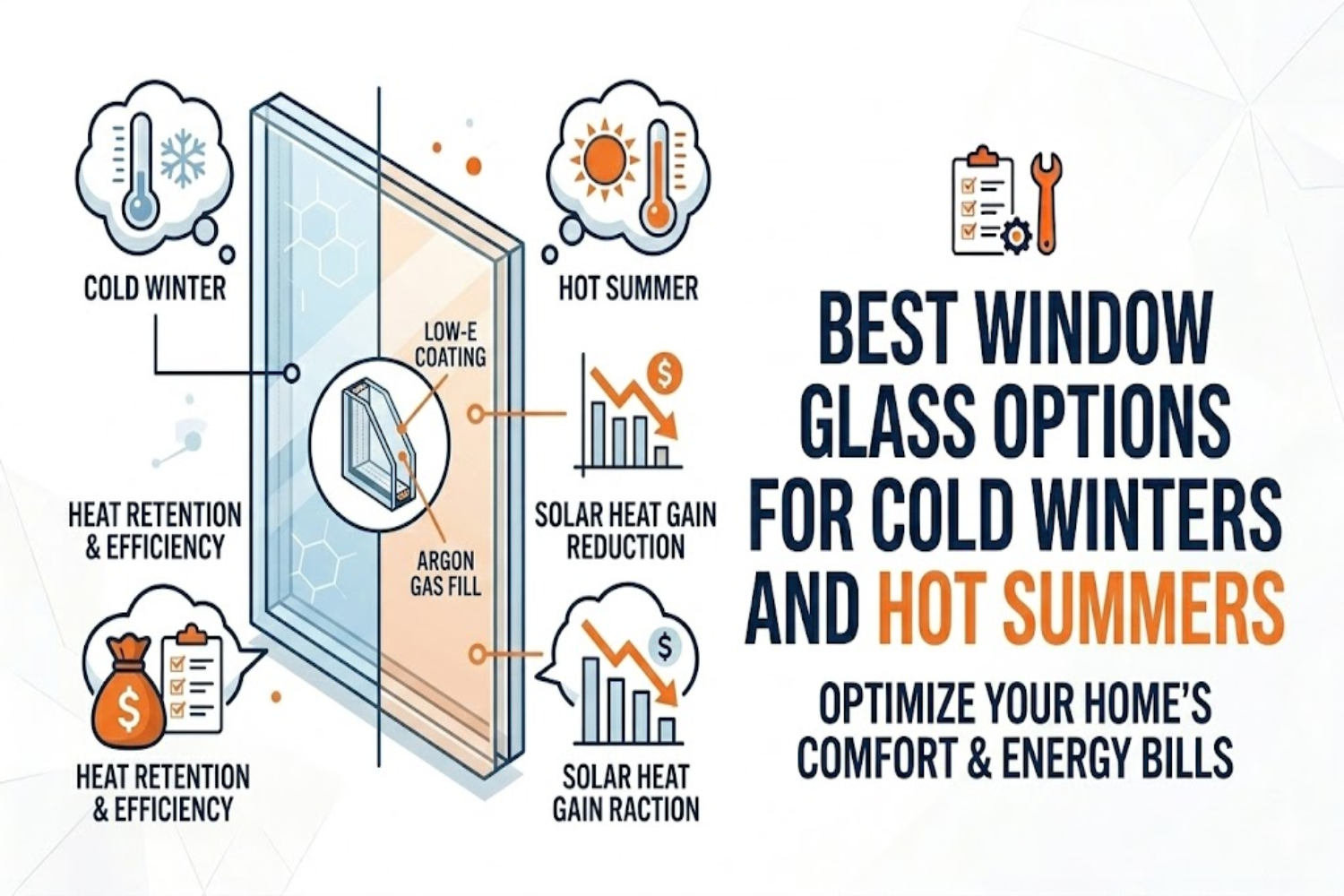
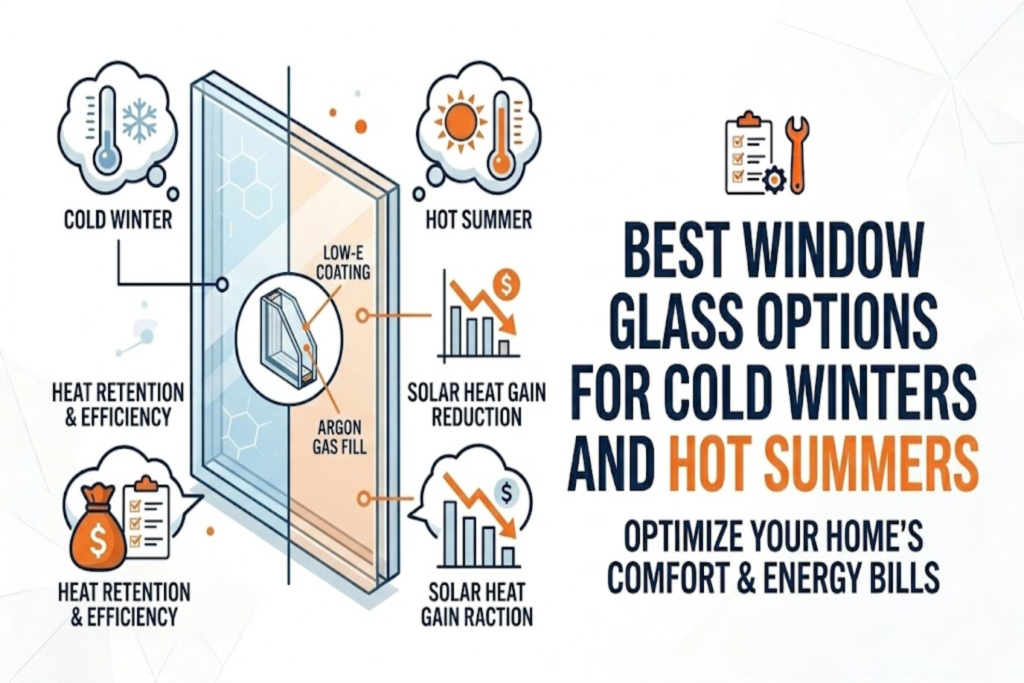
Regions with distinct cold winters and hot summers place conflicting demands on window glass: maximum heat retention in winter versus maximum heat rejection in summer. Single-pane or basic double-pane glass fails at both tasks, allowing rapid heat loss when temperatures drop and massive solar gain when the sun is intense. Modern multi-layer glass with selective coatings solves this dual challenge by reflecting infrared heat differently d
epending on direction—keeping interior warmth inside during winter and bouncing solar heat away during summer. Inert gas fills (argon or krypton) further reduce conductive heat transfer in both directions. Triple glazing adds another insulating layer for extreme conditions. Choosing climate-appropriate glass dramatically lowers heating and cooling loads while preventing uncomfortable hot/cold spots near windows.
Proper installation is critical for achieving rated U-factor and SHGC values—poor sealing, frame misalignment, or inadequate flashing can reduce performance by 20–40%. Certified installers use correct shims, flashing tapes, and sealants to prevent air and water infiltration. They also ensure weep holes and drainage paths remain functional. Incorrect installation can void warranties and cause premature seal failure. Choosing experienced professionals guarantees the glass performs as advertised. Quality installation maximizes every dollar spent on advanced glass.
Understanding U-Factor and Solar Heat Gain Coefficient (SHGC)
- U-factor measures how easily heat passes through the entire window assembly—lower numbers (0.15–0.30) indicate better winter insulation.
- SHGC measures how much solar heat is transmitted through the glass—lower numbers (0.25–0.40) indicate better summer heat rejection.
- The best glass for cold winters + hot summers balances a low U-factor with a moderate-to-low SHGC, often achieved through double or triple low-E coatings tuned for mixed climates.
- ENERGY STAR guidelines for the Northern/Central climate zone recommend U-factor ≤ 0.30 and SHGC ≤ 0.40.
- Selecting glass that meets or exceeds these targets maximizes year-round performance.
Low-E Coatings – The Foundation of Year-Round Efficiency
Low-emissivity (low-E) coatings are microscopically thin metallic layers applied to one or more glass surfaces that reflect infrared heat while transmitting visible light. Soft-coat (sputtered) low-E provides superior performance in mixed climates; hard-coat (pyrolytic) offers durability but slightly less efficiency. In winter, low-E reflects room heat back inside; in summer, it reflects solar heat away. Most modern windows use double low-E (one on surface #2 and one on surface #4) or high-performance variants with three coatings. These coatings can reduce heat transfer by 50–70% compared to uncoated glass. Low-E is the single most important upgrade for homes facing both cold winters and hot summers.
Proper installation is critical for achieving rated U-factor and SHGC values—poor sealing, frame misalignment, or inadequate flashing can reduce performance by 20–40%. Certified installers use correct shims, flashing tapes, and sealants to prevent air and water infiltration. They also ensure weep holes and drainage paths remain functional. Incorrect installation can void warranties and cause premature seal failure. Choosing experienced professionals guarantees the glass performs as advertised. Quality installation maximizes every dollar spent on advanced glass.
Different Types of Low-E for Mixed Climates
Passive low-E (high solar gain) works best in predominantly heating climates—allowing more solar warmth inside during winter. Solar-control low-E (low solar gain) excels in cooling-dominated climates—rejecting heat in summer. High-performance dual-zone low-E balances both, offering moderate SHGC (around 0.30–0.35) with very low U-factors. Triple-silver low-E coatings provide the best overall performance for regions with significant heating and cooling needs. Professional installers match coating type to your home’s orientation and local climate data.
Inert Gas Fills – Boosting Insulation Without Adding Thickness
Argon and krypton gases fill the space between panes to slow conductive and convective heat transfer far better than air. Argon reduces U-factor by about 0.04–0.06 points; krypton offers even greater improvement in narrower gaps. Gas fills are standard in quality double-pane and triple-pane windows today. When seals fail, gas escapes and efficiency drops sharply—making gas re-injection during repair one of the highest-ROI fixes available. Properly filled units maintain stable performance for 15–30 years. Gas fill is especially valuable in cold-winter climates where conductive heat loss dominates energy bills.
Argon vs Krypton – Which Gas Is Better?
Argon is less expensive and provides excellent performance in standard 1/2-inch gaps—reducing U-factor by approximately 0.05 points. Krypton delivers superior insulation in narrower spaces (3/8 inch or less) and is often used in premium triple-pane units. Krypton costs more but offers diminishing returns in wider gaps. Most mixed-climate homes benefit most from argon-filled double or triple glazing. Professional services can test and re-inject either gas during repairs.
Triple-Pane Glass – Maximum Performance for Extreme Climates
Triple-pane windows use three glass layers with two sealed air/gas spaces, achieving U-factors as low as 0.15–0.20—nearly double the insulation of standard double-pane. The extra pane and spacer dramatically reduce heat transfer in both directions, making triple glazing ideal for homes with very cold winters and hot summers. Modern triple-pane units often include double low-E coatings and krypton fill for optimal year-round performance. While heavier and more expensive, triple-pane windows deliver the highest comfort and efficiency gains. They also provide superior noise reduction and condensation resistance.
Proper installation is critical for achieving rated U-factor and SHGC values—poor sealing, frame misalignment, or inadequate flashing can reduce performance by 20–40%. Certified installers use correct shims, flashing tapes, and sealants to prevent air and water infiltration. They also ensure weep holes and drainage paths remain functional. Incorrect installation can void warranties and cause premature seal failure. Choosing experienced professionals guarantees the glass performs as advertised. Quality installation maximizes every dollar spent on advanced glass.
When Triple-Pane Is Worth the Extra Cost
Triple-pane makes the most sense in homes with large window areas, northern or western exposures, high energy rates, or owners planning long-term residency. The additional cost (typically $200–$600 more per window than double-pane) is offset by greater savings in extreme climates. Triple-pane also increases home resale value in efficiency-conscious markets. For moderate climates, high-performance double-pane often suffices.
| Glass Configuration | Typical U-Factor Range | Typical SHGC Range | Annual Energy Savings Estimate | Noise Reduction (STC) | Best For Mixed Cold/Hot Climates |
| Standard Double-Pane (air-filled) | 0.48 – 0.55 | 0.70 – 0.78 | Baseline | 28–32 | Minimal performance |
| Double-Pane + Low-E + Argon | 0.25 – 0.35 | 0.25 – 0.40 | $150 – $350 | 30–35 | Good all-season balance |
| High-Performance Double-Pane (triple silver low-E + argon) | 0.20 – 0.28 | 0.22 – 0.30 | $250 – $500 | 32–38 | Excellent year-round efficiency |
| Triple-Pane + Double Low-E + Krypton | 0.15 – 0.22 | 0.20 – 0.30 | $350 – $700 | 35–42 | Maximum performance & comfort |
| Triple-Pane + Acoustic Laminate | 0.16 – 0.24 | 0.22 – 0.32 | $300 – $600 | 38–45 | Noise-sensitive + efficiency |
Professional Installation – Why It Matters for Performance
Proper installation is critical for achieving rated U-factor and SHGC values—poor sealing, frame misalignment, or inadequate flashing can reduce performance by 20–40%. Certified installers use correct shims, flashing tapes, and sealants to prevent air and water infiltration. They also ensure weep holes and drainage paths remain functional. Incorrect installation can void warranties and cause premature seal failure. Choosing experienced professionals guarantees the glass performs as advertised. Quality installation maximizes every dollar spent on advanced glass.
Proper installation is critical for achieving rated U-factor and SHGC values—poor sealing, frame misalignment, or inadequate flashing can reduce performance by 20–40%. Certified installers use correct shims, flashing tapes, and sealants to prevent air and water infiltration. They also ensure weep holes and drainage paths remain functional. Incorrect installation can void warranties and cause premature seal failure. Choosing experienced professionals guarantees the glass performs as advertised. Quality installation maximizes every dollar spent on advanced glass.
Combining Glass Upgrades with Other Efficiency Measures
While upgrading glass is highly effective, combining it with attic insulation, air sealing around frames, and high-efficiency HVAC systems amplifies savings significantly. Exterior shading (awnings, overhangs) further reduces summer heat gain. Interior cellular shades or smart blinds add temporary insulation. Layered improvements often yield greater total energy reduction than glass alone. Professional energy audits identify the highest-impact combinations for your specific home.
Conclusion
The best window glass for cold winters and hot summers combines low U-factor (winter insulation), moderate-to-low SHGC (summer heat rejection), inert gas fills, and high-quality low-E coatings—usually achieved with high-performance double-pane or triple-pane configurations. Double-pane with dual low-E and argon offers excellent all-season balance for most homes; triple-pane with krypton provides maximum efficiency in more extreme conditions.
In Woodbridge VA, where winters regularly dip below freezing and summers bring high heat and humidity, investing in the right glass dramatically reduces HVAC workload and stabilizes indoor temperatures. Modern options also deliver noise reduction, UV protection, and improved security as added benefits. Professional energy audits and on-site quotes help match the exact configuration to your home’s orientation, window area, and budget. The right glass choice transforms uncomfortable rooms into consistently pleasant spaces while delivering strong long-term savings.
Frequently Asked Questions
- What is the best U-factor and SHGC for mixed cold/hot climates?
For regions with both heating and cooling seasons, aim for U-factor ≤ 0.30 and SHGC between 0.25–0.40. High-performance double-pane with dual low-E and argon typically achieves this range. Triple-pane can go lower on U-factor while maintaining good SHGC.
- Is triple-pane glass worth the extra cost over double-pane?
Yes, if your home has large window areas, very cold winters, or high energy rates—triple-pane delivers 20–40% better insulation than double-pane. Payback occurs faster in extreme climates. For moderate conditions, high-performance double-pane often provides sufficient performance.
- Do low-E coatings work well in both winter and summer?
Yes—high-performance low-E coatings reflect interior heat back inside during winter and reject solar heat during summer. Dual-zone or triple-silver low-E variants are specifically designed for mixed climates. They provide year-round benefits without darkening rooms excessively.
- How much can I save on energy bills with the right glass upgrade?
Upgrading from single-pane or failed double-pane to high-performance double or triple-pane typically reduces heating/cooling costs by 20–50% on window-related losses—often $200–$700 annually for average homes. Exact savings depend on window area, orientation, and climate.
- Does argon or krypton gas make a big difference?
Yes—argon reduces U-factor by about 0.05 points; krypton offers greater improvement in narrower gaps. Both gases are far better insulators than air. Gas fill is standard in quality modern windows and significantly boosts efficiency.
- Can I add low-E or gas fill to existing double-pane windows?
In many cases, yes—specialized repair services can apply low-E film or re-inject gas during fog removal and resealing. These upgrades are cost-effective when the frame remains sound. Full IGU replacement achieves the most consistent results.
- How does window orientation affect the best glass choice?
South- and west-facing windows need lower SHGC to control summer heat gain; north-facing windows benefit most from very low U-factor for winter heat retention. East-facing windows balance both needs. Professionals optimize glass specifications per exposure.
- Do high-performance windows increase home resale value?
Yes—ENERGY STAR-rated double or triple-pane windows with low-E and gas fill are attractive to buyers and often increase resale value by $5,000–$15,000 depending on home size. Energy efficiency certifications appear on listing reports and appraisals.
- Are there tax credits or rebates for upgrading to better glass?
Yes—qualifying ENERGY STAR windows, low-E coatings, and gas-filled units often earn federal tax credits (up to $600 per window in recent programs) or local utility rebates. Check current incentives during planning. Rebates significantly reduce effective cost.
- What maintenance do high-performance windows require?
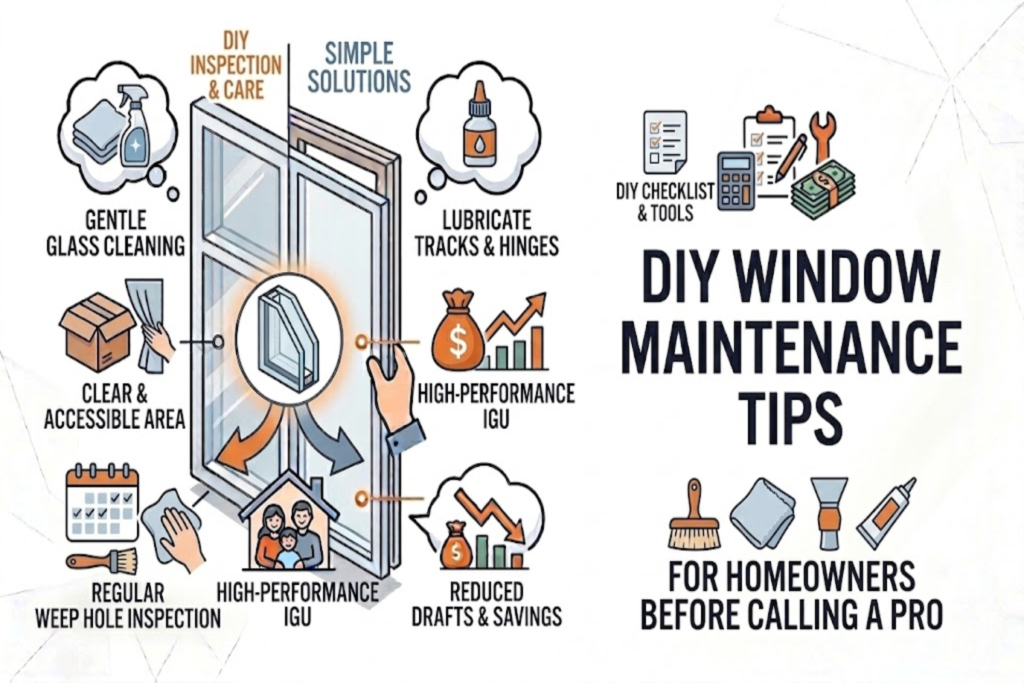
Maintenance remains similar to standard windows—clean with ammonia-free solutions and microfiber cloths, inspect seals annually, keep weep holes clear, and lubricate hardware. Avoid abrasive cleaners that could damage coatings. Proper care preserves efficiency for decades.
Visit our DMV Window Repairs LLC blog to explore our residential and commercial glass services for customers in Woodbridge, VA.