
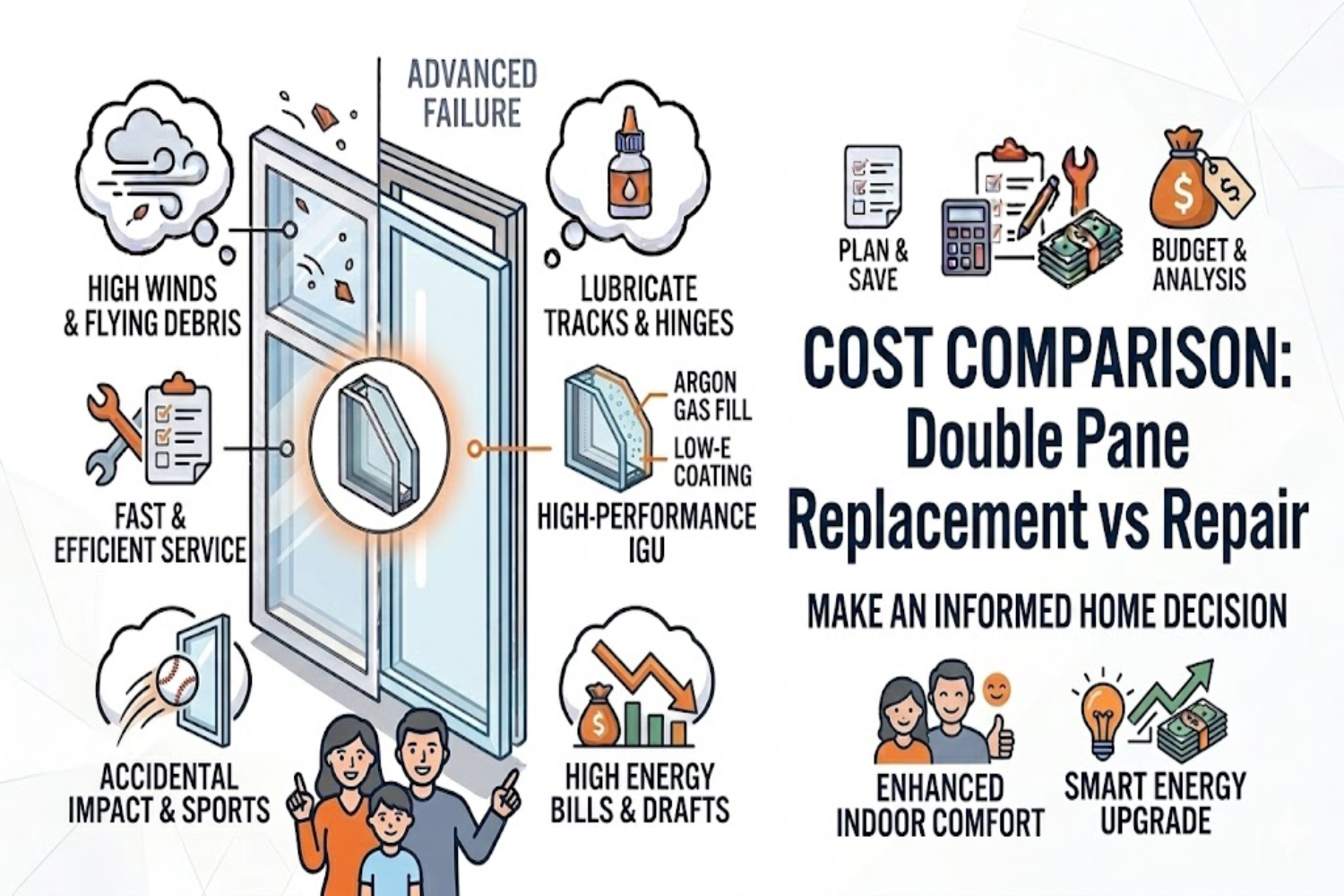
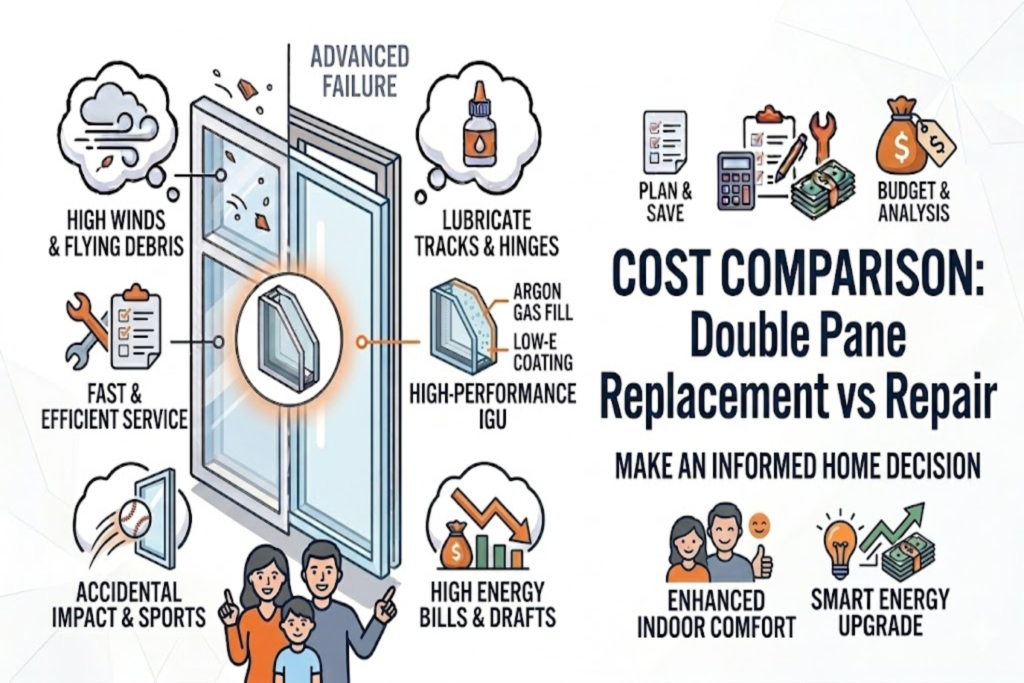
Deciding between repairing your existing double-pane windows or replacing them entirely is one of the most common dilemmas homeowners face when fogging, drafts, or rising energy bills appear. Repair typically focuses on restoring the insulated glass unit (IGU) by resealing, removing moisture, replacing desiccant, and re-injecting argon or krypton gas—often at a fraction of replacement cost. Full replacement involves removing the old window, installing a new frame and sash, and incorporating modern energy-efficient glass with low-E coatings and advanced spacers.
While repair saves significant upfront money, replacement delivers superior long-term performance, better warranties, and higher overall efficiency gains. The best choice depends on window age, frame condition, extent of damage, climate exposure, and your plans for the home. Accurate cost comparisons require professional on-site quotes, but general ranges help set realistic expectations. This guide breaks down typical expenses, hidden factors, and long-term value for both options. Understanding these differences ensures you invest wisely in your home’s comfort and efficiency.
Typical Cost Range for Double-Pane Repair
Double-pane repair usually targets the failed insulated glass unit while preserving the existing frame, sash, and hardware. Basic fog removal and resealing (draining moisture, replacing desiccant, resealing edges) averages $250–$500 per window. Adding argon or krypton gas re-injection increases the price to $300–$650. If the low-E coating is damaged or absent, applying new low-E film during repair adds $100–$400.
Edge seal reinforcement or micro-drilling techniques to restore airtightness without full disassembly typically fall in the $350–$700 range. Labor dominates pricing since the process requires precision tools, controlled environments, and skilled technicians. Most repairs complete in 1–4 hours per window. Repair remains the lower-cost option when frames are sound and failure is limited to seals.
Breakdown of Repair Cost Components
Material costs (desiccant, sealant, replacement spacers, optional gas) usually represent 20–40% of the total, ranging $50–$250 per window. Labor for disassembly, cleaning, reassembly, and testing accounts for 50–70% ($150–$400). Disposal of old components and cleanup add $25–$75. Travel or trip fees may apply for distant locations. Warranties (typically 5–15 years on resealed units) are often included. Transparent companies provide itemized quotes showing each element clearly. Repair pricing stays predictable when limited to seal-related issues.
Typical Cost Range for Full Double-Pane Replacement
- Full double-pane window replacement includes removing the old unit, installing a new frame and sash, and fitting modern insulated glass with energy-efficient features.
- Standard vinyl double-hung replacements average $500–$1,200 per window, including labor and basic low-E glass.
- Premium vinyl or fiberglass frames with triple-pane, argon-filled, low-E coated glass range $800–$1,800+.
- Wood or clad-wood options often exceed $1,000–$2,500 per window.
- Custom shapes (arches, bays, large picture windows) push prices toward $1,500–$4,000+.
- Installation labor typically comprises 30–50% of the total ($200–$800 per window).
- Bulk projects for 8–12 windows frequently reduce per-unit costs by 10–25%.
Additional Expenses in Full Replacement Projects
Disposal of old windows and debris costs $50–$200 per load. Permits (required in some areas for exterior changes) add $50–$250. Siding or drywall repairs around openings run $100–$500 per window if trim damage occurs. Travel surcharges or equipment fees for upper floors apply occasionally. Taxes and any HOA review fees contribute smaller amounts. Most companies include basic cleanup and disposal in quotes. Request fully itemized proposals to identify all potential extras upfront.
Repair vs Replacement: Head-to-Head Cost Comparison
Repair almost always costs less initially—$250–$800 per window versus $500–$2,500+ for replacement. Repair preserves existing frames and avoids major disruption (interior trim, exterior siding, painting). Replacement provides brand-new performance with modern low-E, gas fills, warm-edge spacers, and stronger warranties (often 20–life-of-product). Repair typically restores 70–90% of original efficiency; replacement achieves 100% with superior specifications. Long-term energy savings from replacement often outpace repair within 5–10 years. Repair suits newer windows (under 15–20 years) with isolated seal failure; replacement becomes more economical for older units showing multiple symptoms.
While repair saves significant upfront money, replacement delivers superior long-term performance, better warranties, and higher overall efficiency gains. The best choice depends on window age, frame condition, extent of damage, climate exposure, and your plans for the home. Accurate cost comparisons require professional on-site quotes, but general ranges help set realistic expectations. This guide breaks down typical expenses, hidden factors, and long-term value for both options. Understanding these differences ensures you invest wisely in your home’s comfort and efficiency.
Long-Term Value and Payback Period Analysis
Repair payback usually occurs in 2–7 years through energy savings of $50–$250 annually per window. Replacement payback ranges 5–12 years but delivers greater total savings ($150–$500+ per year) and increases home resale value noticeably. Replacement also eliminates future repair cycles and provides better noise reduction, UV protection, and comfort. When frames remain sound, repair offers the fastest ROI; when frames show wear, replacement maximizes long-term value.
Hidden Costs and Factors That Affect Both Options
Emergency or after-hours service adds $100–$300 premiums for either repair or replacement. Disposal fees ($50–$200) apply to both but are higher for full replacement. Accessibility challenges (upper floors, tight spaces) increase labor $50–$300 per window. Upgrades like acoustic laminates or impact-resistant glass add $200–$800. Taxes, permits, and any drywall/siding repairs contribute extra. Quotes that seem too low often exclude disposal, cleanup, or warranty coverage. Always compare fully itemized proposals.
While repair saves significant upfront money, replacement delivers superior long-term performance, better warranties, and higher overall efficiency gains. The best choice depends on window age, frame condition, extent of damage, climate exposure, and your plans for the home. Accurate cost comparisons require professional on-site quotes, but general ranges help set realistic expectations. This guide breaks down typical expenses, hidden factors, and long-term value for both options. Understanding these differences ensures you invest wisely in your home’s comfort and efficiency.
Energy Savings Comparison After Repair vs Replacement
Repairing failed double-pane units typically restores 15–35% of lost efficiency, saving $80–$300 annually per home depending on window count. Full replacement with modern triple-pane low-E argon units often achieves 30–50%+ overall window efficiency improvement, yielding $200–$600+ in yearly savings. Replacement savings grow larger in homes with many windows or extreme temperature swings. Energy audits before and after work provide objective measurement of improvement.
| Option | Average Cost Per Window | Efficiency Recovery | Annual Energy Savings Estimate | Typical Payback Period | Best For |
| Basic reseal + fog removal | $250 – $500 | 70–85% | $50 – $150 | 3–7 years | Newer windows, isolated seal failure |
| Reseal + argon/krypton re-injection | $300 – $650 | 80–95% | $100 – $250 | 2–6 years | Maximum gas-fill restoration |
| Reseal + low-E upgrade | $400 – $800 | 85–100%+ | $120 – $300 | 3–7 years | Adding solar control during repair |
| Full IGU replacement (standard) | $350 – $700 | 90–100% | $150 – $350 | 3–8 years | When frame is good but IGU failed completely |
| Full window replacement (vinyl) | $500 – $1,200 | 100%+ (modern specs) | $200 – $500 | 5–12 years | Aging frames, multiple failing units |
| Full window replacement (premium) | $800 – $2,000+ | 110–130% (vs old) | $250 – $600+ | 6–15 years | Long-term ownership, maximum performance |
Tips for Getting the Most Accurate Cost Comparison
Request written, itemized quotes from at least three licensed professionals—each should include labor, materials, disposal, cleanup, warranties, and any upgrades. Provide clear photos of each window and describe symptoms (fogging extent, drafts, operation issues) for precise estimates. Ask for before-and-after U-factor or energy savings projections. Inquire about seasonal discounts, financing options, manufacturer rebates, or utility incentives. Verify credentials, insurance, and references before committing. Thorough quote comparison ensures you select the best value without compromising quality.
While repair saves significant upfront money, replacement delivers superior long-term performance, better warranties, and higher overall efficiency gains. The best choice depends on window age, frame condition, extent of damage, climate exposure, and your plans for the home. Accurate cost comparisons require professional on-site quotes, but general ranges help set realistic expectations. This guide breaks down typical expenses, hidden factors, and long-term value for both options. Understanding these differences ensures you invest wisely in your home’s comfort and efficiency.
Long-Term Considerations: Repair vs Replacement ROI
Repair offers faster payback (2–7 years) and minimal disruption but may require future attention if underlying issues persist. Replacement provides greater total savings over 15–30 years, better warranties, superior noise/UV/security performance, and increased resale appeal. Energy audits quantify exact ROI based on your home’s window count, orientation, and utility rates. Layering repairs with other efficiency measures (attic insulation, air sealing) amplifies returns. Long-term planning helps maximize financial benefits regardless of the chosen path.
While repair saves significant upfront money, replacement delivers superior long-term performance, better warranties, and higher overall efficiency gains. The best choice depends on window age, frame condition, extent of damage, climate exposure, and your plans for the home. Accurate cost comparisons require professional on-site quotes, but general ranges help set realistic expectations. This guide breaks down typical expenses, hidden factors, and long-term value for both options. Understanding these differences ensures you invest wisely in your home’s comfort and efficiency.
Conclusion
Repairing double-pane windows almost always costs less upfront than replacement and delivers strong energy efficiency gains when frames remain in good condition and failure is limited to seals or gas loss. Replacement becomes the better long-term investment when windows are older, frames show wear, multiple failures exist, or you want modern low-E, triple-pane, or acoustic upgrades. In Woodbridge VA, where seasonal temperature extremes and humidity accelerate seal wear, both options offer meaningful savings—repair for quick, targeted fixes and replacement for comprehensive, future-proof performance. Accurate on-site quotes and energy audits provide the clearest comparison of costs versus expected savings. Factor in your timeline, budget, home value goals, and comfort priorities when deciding. Whether you choose repair or replacement, addressing failed double-pane windows promptly protects your wallet, comfort, and home efficiency for years to come.
Frequently Asked Questions
- How much cheaper is repairing double-pane windows compared to full replacement?
Repair typically costs 40–70% less than replacement—averaging $250–$800 per window versus $500–$2,000+ for full units. Repair preserves existing frames and avoids major disruption. Savings are greatest when failure is limited to seals or gas loss. Professional quotes provide exact comparisons.
- Does repairing double-pane windows restore full energy efficiency?
Quality repair (resealing + gas re-injection + optional low-E) usually recovers 70–95% of original performance. Full IGU replacement achieves 100% with modern specifications. Most homeowners notice significant bill reductions and improved comfort after repair. Gas re-injection delivers some of the highest efficiency gains.
- When does replacement become cheaper than repeated repairs?
Replacement often proves more economical when windows exceed 20–25 years, multiple units fail, or frames show rot/warping. Repairing the same windows repeatedly accumulates costs quickly. Professional assessment determines the break-even point based on your specific situation.
- Are there hidden costs in double-pane repair that affect the total price?
Common extras include disposal fees ($50–$150), emergency premiums ($100–$300), accessibility surcharges for upper floors ($50–$200), and optional upgrades like low-E or acoustic glass ($100–$500). Most reputable companies include cleanup and basic labor in quotes. Always request fully itemized proposals.
- How long do repaired double-pane windows typically remain efficient?
High-quality resealing with modern materials and gas re-injection usually lasts 10–20 years or more. Warranties commonly cover 5–15 years. Proper installation and periodic inspection extend performance. Longevity depends on original unit age and exposure conditions.
- Can low-E coating be added during double-pane window repair?
Yes—many repair specialists apply low-E film or upgrade to low-E glass when the IGU is opened for fog removal or resealing. This upgrade improves both winter heat retention and summer solar control at relatively low incremental cost. It maximizes efficiency gains during repair.
- Will repairing double-pane windows reduce my heating and cooling bills noticeably?
Most homeowners experience 15–35% reductions in heating/cooling costs on affected windows after repair, translating to $100–$400 annual savings depending on window count and climate. Gas re-injection and low-E addition during repair often yield the largest bill reductions.
- Is it better to repair or replace double-pane windows over 15 years old?
Repair is often worthwhile if frames remain sound and failure is isolated to seals. Windows over 20–25 years with multiple symptoms (fogging, drafts, bowing) usually justify full replacement for superior long-term efficiency and warranties. On-site evaluation determines the best financial choice.
- Does repairing double-pane glass improve noise reduction as well?
Partially—restoring the sealed gas-filled gap improves sound insulation compared to a failed, air-filled unit. For maximum noise reduction, request acoustic laminated glass during repair or replacement. The difference is most noticeable near busy roads or flight paths.
- What should I look for in a professional quote for double-pane repair vs replacement?
Request itemized breakdowns showing labor, materials, disposal, cleanup, warranties, and any upgrades. Ask for before-and-after efficiency estimates (U-factor/SHGC) and annual savings projections. Verify credentials, insurance, references, and warranty coverage. Compare at least three detailed quotes for transparency and best value.
Visit our DMV Window Repairs LLC blog to explore our residential and commercial glass services for customers in Woodbridge, VA.