
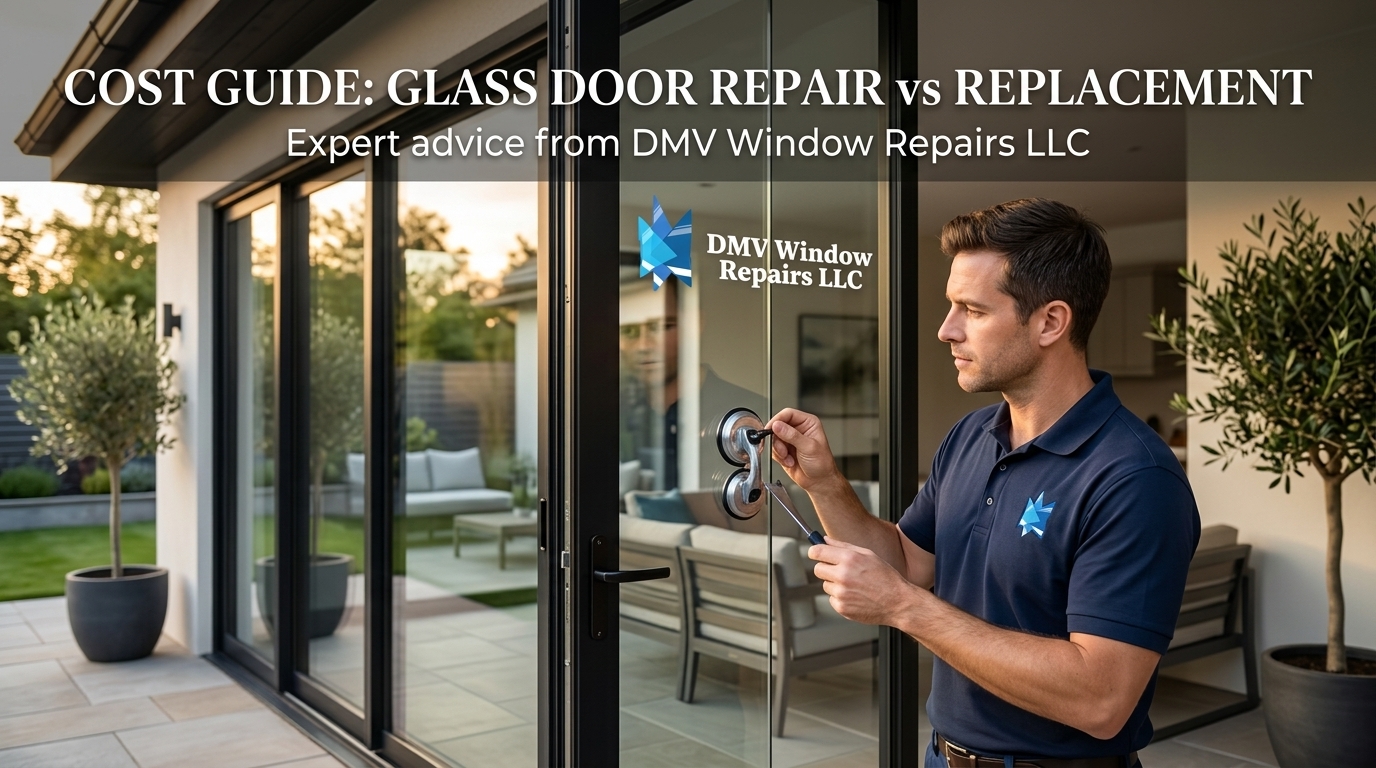
Deciding between repairing or replacing glass doors like sliding patio doors, French doors, or fixed panels involves weighing immediate costs against long-term value, performance, energy savings, and home comfort. Repairs often fix specific issues such as worn rollers, broken handles, misaligned tracks, damaged weatherstripping, or single-pane glass problems at a fraction of replacement prices.
Full replacement becomes necessary when frames rot, multiple components fail simultaneously, insulated glass seals break causing fogging, or outdated designs no longer meet modern efficiency and safety standards. Repair costs typically range from $100–$1,500 depending on the problem, while complete replacements start around $1,500–$8,000+ including labor and materials. Factors like door size, material (vinyl, fiberglass, aluminum, wood), glass type (single, double, triple-pane, Low-E, impact-resistant), and regional labor rates influence final numbers significantly. Choosing wisely prevents wasting money on repeated repairs for failing systems or missing out on energy rebates and increased property value from new installations.
This guide breaks down realistic costs, common scenarios, and decision factors so homeowners can make informed, budget-smart choices.Accurate on-site assessments from qualified professionals provide the clearest picture of costs and benefits. Investing thoughtfully avoids wasting money on temporary patches or missing substantial long-term savings and home value gains. Whether repairing targeted problems or upgrading entirely, the right choice enhances daily living while protecting your property investment effectively for decades.
Common Repair Scenarios and Typical Costs
Most glass door repairs target isolated mechanical or cosmetic issues that do not affect the entire unit. Roller replacement stands out as one of the most frequent and affordable fixes—worn rollers cause dragging, sticking, and uneven operation. Track cleaning and realignment resolve friction from debris buildup without part replacement.
Weatherstripping and threshold seal repairs eliminate drafts and improve energy efficiency quickly. Handle or lock mechanism fixes restore smooth security without major disassembly. These targeted repairs usually cost far less than replacement while restoring near-original performance when the frame and glass remain structurally sound. Professional service ensures proper adjustment and warranty compliance.
Accurate on-site assessments from qualified professionals provide the clearest picture of costs and benefits. Investing thoughtfully avoids wasting money on temporary patches or missing substantial long-term savings and home value gains. Whether repairing targeted problems or upgrading entirely, the right choice enhances daily living while protecting your property investment effectively for decades.
Roller and Track Repairs
Worn or seized rollers require removal of the heavy door panel, cleaning of brackets, and installation of new high-quality replacements with sealed bearings. Costs range from $150–$450 including labor for a standard sliding door. Deep track cleaning and lubrication add $75–$150 if done professionally. Misaligned tracks from house settling need shimming and roller height adjustment, typically $200–$500. These fixes eliminate dragging and noise while extending door life significantly. Many homeowners report smooth operation restored for years after these repairs.
Weatherstripping and Seal Replacement
- Compressed, cracked, or missing weatherstripping around jambs, head, and threshold creates drafts and energy loss.
- Replacement with high-quality EPDM or silicone strips costs $100–$350 including labor.
- Threshold sweeps or bottom gaskets wear from foot traffic and cost $80–$250 to renew.
- Perimeter caulking and minor frame sealing add $50–$200.
- These inexpensive updates dramatically reduce air infiltration and utility bills.
- Proper installation ensures long-lasting compression and weather resistance.
Handle, Lock, and Hardware Fixes
Stiff multi-point locks or corroded handles result from lack of lubrication or wear. Cleaning, lubricating, and adjusting mechanisms costs $75–$250. Full handle replacement with ergonomic modern designs runs $150–$400. Strike plate realignment or new deadbolts add $100–$300. These repairs restore secure, easy operation without affecting glass or frame integrity. Upgraded hardware often improves both function and curb appeal.
When Replacement Makes More Financial Sense
Replacement becomes the smarter financial decision when repair costs approach 50–60% of a new door system price or when multiple components fail simultaneously. Fogged insulated glass units indicate permanent seal failure—replacing the entire panel costs nearly as much as new doors in many cases. Rotted or warped frames from water intrusion require structural fixes that exceed simple repairs. Outdated single-pane or non-Low-E glass wastes energy and fails modern codes. New doors offer triple-pane options, advanced Low-E coatings, impact resistance, and better hardware that deliver 20–40% utility savings. Rebates, tax credits, and increased resale value often offset higher upfront costs significantly.
Accurate on-site assessments from qualified professionals provide the clearest picture of costs and benefits. Investing thoughtfully avoids wasting money on temporary patches or missing substantial long-term savings and home value gains. Whether repairing targeted problems or upgrading entirely, the right choice enhances daily living while protecting your property investment effectively for decades.
Signs That Replacement Outweighs Repair
Persistent fogging between panes means the insulated unit has failed permanently. Visible rot or soft spots in wooden frames indicate advanced water damage. Repeated roller, track, and seal repairs within a few years signal overall system fatigue. Energy bills remain high despite fixes due to poor glazing performance. Doors no longer meet current wind-load or impact codes in storm-prone regions. These indicators show that continued repairs provide diminishing returns compared to modern replacements.
Full Replacement Cost Breakdown
Basic vinyl sliding doors with double-pane Low-E start at $1,500–$3,000 installed. Fiberglass or thermally broken aluminum models range $3,000–$6,000. Premium triple-pane, impact-resistant, or smart-glass doors reach $5,000–$10,000+. Labor typically adds $500–$1,500 depending on size and complexity. Removal and disposal of old units cost $200–$500. Permits and inspections add $100–$300 in most areas. New doors qualify for energy rebates ($100–$1,000) and increase home value noticeably.
| Scenario / Component | Repair Cost Range (incl. labor) | Replacement Cost Range (incl. install) | Break-Even Point (when repair ≈ 50–60% of new) | Long-Term Savings with Replacement | Lifespan After Fix/Action | Energy Efficiency Gain | Best Choice When… |
| Worn Rollers & Track Cleaning | $150–$450 | $1,500–$8,000 | Rarely—repair always cheaper | Minimal | 5–10 years | None | Frame/glass good |
| Weatherstripping & Threshold Seals | $100–$350 | $1,500–$8,000 | Never—repair far lower | $50–$200/year on bills | 7–12 years | Moderate | Drafts only issue |
| Fogged Insulated Glass Unit | $400–$1,200 (panel only) | $2,000–$8,000 | Often—repair close to partial replacement | High—better glazing | 20–30 years | Significant | Seal failed |
| Stiff Handles / Multi-Point Locks | $75–$400 | $1,500–$8,000 | Never—repair much cheaper | Minimal | 10–15 years | None | Hardware only |
| Frame Rot or Warping | $800–$3,000+ (structural) | $2,500–$10,000 | Almost always—repair approaches full cost | Very High—new materials | 25–40+ years | High | Structural damage |
| Single-Pane to Low-E Upgrade | $800–$2,000 (glass insert) | $2,000–$8,000 | Frequently—insert cost nears basic new door | $200–$600/year | 20–30 years | Dramatic | Energy priority |
| Impact-Resistant or Triple-Pane | Rarely repairable | $4,000–$12,000 | Always replacement | $300–$800/year + safety | 25–40+ years | Outstanding | Storm/security |
| Complete Door System Failure | $1,000–$4,000+ piecemeal | $2,500–$10,000 | Usually—cumulative repair exceeds new | Highest overall | 25–40+ years | Maximum | Multiple failures |
Additional Cost Factors to Consider
Labor rates vary widely—urban areas and certified specialists charge $75–$150 per hour while rural or general contractors may cost less. Door size directly impacts pricing—standard 6–8 ft sliders sit lower while oversized multi-panel or bi-fold systems raise costs sharply. Material upgrades (fiberglass over vinyl, impact glass over standard) add $1,000–$5,000+. Energy Star certification and Low-E features qualify for rebates up to $1,000 in many programs.
Disposal fees for old heavy doors range $100–$400. Permits and inspections add $100–$500 depending on local requirements. Financing options and manufacturer promotions often appear seasonally. Accurate quotes require on-site measurements from multiple providers.
Woodbridge VA homeowners often find repair costs moderate while replacement offers strong energy savings in variable mid-Atlantic weather.
Woodbridge VA residents benefit from comparing quotes due to competitive local labor markets.
Woodbridge VA properties see excellent ROI from energy-efficient replacements qualifying for regional incentives.
Woodbridge VA continues to favor professional assessments to determine repair vs replacement accurately.
Financing, Rebates, and Long-Term ROI
Many manufacturers and installers offer 0% interest financing for 12–24 months on replacement projects. Utility companies provide rebates for ENERGY STAR-rated doors with qualifying Low-E or triple-pane glass. Federal tax credits sometimes apply to major energy upgrades. Long-term ROI comes from 15–40% reduced heating/cooling costs, lower maintenance, increased home value (often 70–90% cost recovery at resale), and avoided future repair cycles. Impact-resistant or high-performance doors may earn insurance discounts. Calculating payback period helps—many replacements recover costs within 7–12 years through savings alone. Professional consultation clarifies available incentives and realistic returns.
Accurate on-site assessments from qualified professionals provide the clearest picture of costs and benefits. Investing thoughtfully avoids wasting money on temporary patches or missing substantial long-term savings and home value gains. Whether repairing targeted problems or upgrading entirely, the right choice enhances daily living while protecting your property investment effectively for decades.
Conclusion
The repair vs replacement decision for glass doors hinges on the extent of damage, age of the system, energy performance goals, and budget constraints. Simple mechanical fixes like rollers, seals, and hardware stay economical and deliver quick returns when the frame and glass remain sound. Extensive issues—fogged glass, rotted frames, repeated failures, or outdated single-pane—almost always favor full replacement for superior efficiency, security, comfort, and longevity. Accurate on-site assessments from qualified professionals provide the clearest picture of costs and benefits.
Investing thoughtfully avoids wasting money on temporary patches or missing substantial long-term savings and home value gains. Whether repairing targeted problems or upgrading entirely, the right choice enhances daily living while protecting your property investment effectively for decades. Accurate on-site assessments from qualified professionals provide the clearest picture of costs and benefits. Investing thoughtfully avoids wasting money on temporary patches or missing substantial long-term savings and home value gains. Whether repairing targeted problems or upgrading entirely, the right choice enhances daily living while protecting your property investment effectively for decades.
Frequently Asked Questions
- When do repair costs make replacement the better financial choice?
Repair costs approaching 50–60% of a new door system price usually signal replacement makes more sense. Multiple failing components or fogged insulated glass push totals higher quickly. New doors bring energy savings and warranties that offset higher upfront expense. Professional quotes clarify the true break-even point.
- How much does it typically cost to replace just the glass in a patio door?
Glass-only replacement (insulated unit) ranges $400–$1,500 depending on size, Low-E, and triple-pane options. Labor adds $300–$800 for safe removal and reinstallation. Total often nears the price of a basic new door. Full replacement frequently provides better value long-term.
- Are there hidden costs I should watch for in glass door repairs?
Hidden costs include panel removal fees, disposal of old parts, emergency service premiums, and follow-up adjustments if alignment issues persist. Water damage discovered during repairs can escalate dramatically. Always request fully itemized quotes to uncover potential extras.
- What factors drive the biggest differences in replacement pricing?
Size (standard vs oversized multi-panel), material (vinyl cheapest, fiberglass/impact premium), glass type (double Low-E basic, triple-pane or smart high-end), and labor rates create the widest ranges. Location-specific codes and disposal fees add variability. Custom features increase totals significantly.
- Do energy-efficient new doors qualify for rebates or tax credits?
Yes—ENERGY STAR-rated doors with qualifying Low-E or triple-pane often earn utility rebates of $100–$1,000. Federal tax credits apply in some years for major efficiency upgrades. Check current programs and keep NFRC labels for documentation. Savings compound with lower bills.
- How long do repairs typically last compared to replacement?
Targeted repairs (rollers, seals, hardware) last 5–15 years with maintenance. Extensive or repeated fixes indicate underlying issues that shorten lifespan. New doors with modern materials and glazing endure 20–40+ years reliably. Replacement usually provides longer trouble-free service.
- Is it cheaper to repair older single-pane doors or replace them entirely?
Repairing single-pane doors rarely makes sense long-term due to poor energy performance. Glass inserts with Low-E cost nearly as much as basic new doors. Full replacement delivers dramatic utility savings and modern features. Most experts recommend upgrading outdated units.
- What should I expect in a professional repair vs replacement quote?
Repair quotes itemize parts (rollers $50–$150 each), labor hours, and any adjustments. Replacement quotes break down door cost, installation, removal/disposal, permits, and optional upgrades. Both should include written warranties and timelines. Compare multiple detailed proposals.
- Can I increase home value more with repair or replacement?
Replacement boosts resale value significantly through energy efficiency, modern appearance, and buyer appeal—often recovering 70–90% of cost. Repairs maintain value but rarely add substantial equity unless addressing safety issues. New high-performance doors impress buyers more noticeably.
- How do I get accurate local cost estimates for my glass doors?
Request on-site visits from 3–5 licensed contractors specializing in doors/windows. Provide door measurements, photos of issues, and age/material details. Ask for itemized breakdowns and references. Check reviews and verify certifications. Accurate quotes prevent surprises and ensure fair comparisons.
Visit our DMV Window Repairs LLC blog to explore our residential and commercial glass services for customers in Woodbridge, VA.