
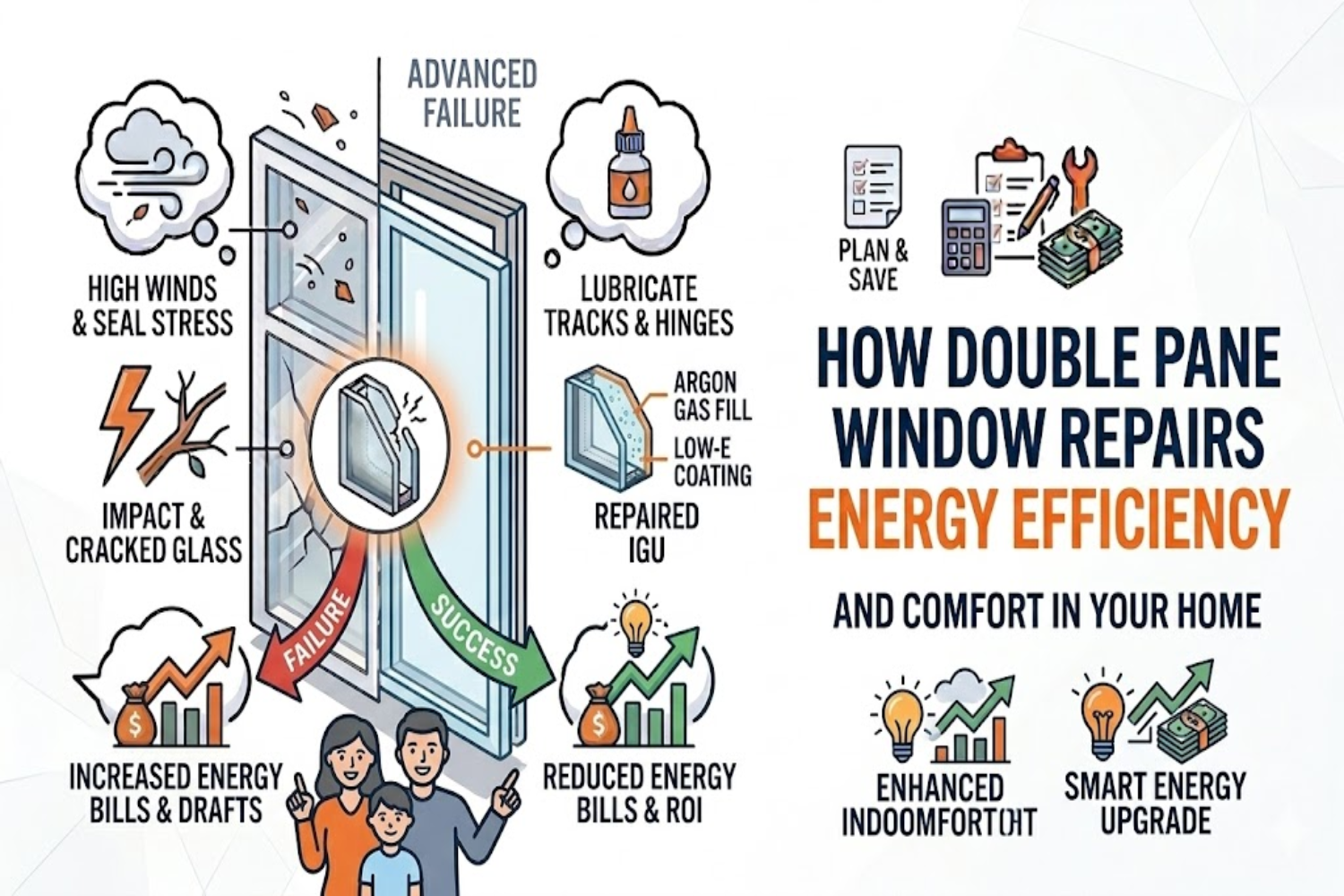
Double pane window repairs restore the original insulating power of your home’s glass, directly addressing the most common sources of energy loss through windows. When seals fail, argon or krypton gas escapes and moisture enters, turning an efficient insulated unit into little more than two poorly performing sheets of glass with air between them. Professional repair—whether resealing, gas re-injection, desiccant replacement, or full insulated glass unit (IGU) swap—recovers much of the lost thermal resistance.
Homeowners typically see noticeable reductions in heating and cooling bills after fixing fogged or leaking double-pane windows. In climates with cold winters and humid summers, these repairs prevent constant HVAC overwork and stabilize indoor temperatures year-round. Beyond energy savings, repaired windows reduce drafts, minimize condensation, and extend the overall life of the existing frames. Timely intervention often costs far less than full window replacement while delivering comparable efficiency gains. This guide explains exactly how repairs improve performance and what results you can realistically expect.
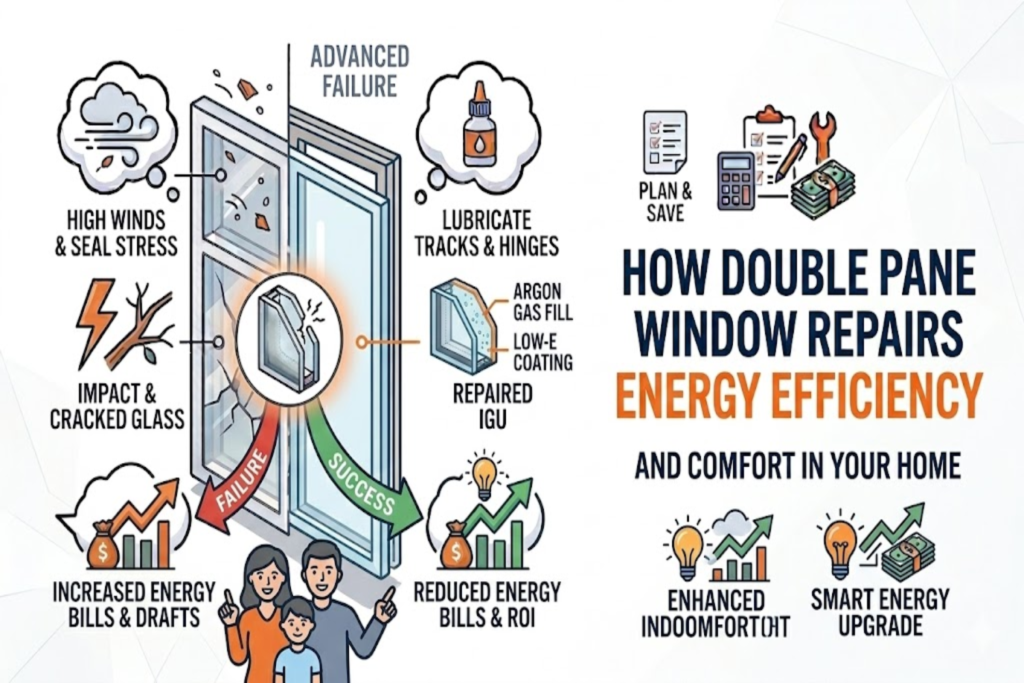
Understanding How Double-Pane Windows Lose Efficiency
Double-pane windows rely on a sealed air or gas space between two glass layers to create thermal resistance. When the perimeter seal fails—due to age, thermal cycling, manufacturing defects, or installation stress—several efficiency-destroying processes begin simultaneously. Inert gas (argon or krypton) leaks out gradually, replaced by regular humid air that conducts heat far more readily.
Moisture trapped inside condenses on the cold inner surfaces during temperature drops, forming permanent fog that further reduces insulation value. The failed seal also allows pressure equalization, which can bow panes slightly and create micro-gaps. Once compromised, a double-pane unit performs similarly to a poorly insulated single pane. Repair reverses most of these losses by restoring the airtight barrier and reintroducing insulating gas.
While repairing double-pane units, consider complementary improvements: adding exterior storm panels, installing cellular shades, sealing frame-to-wall joints, or upgrading attic insulation. These combined measures amplify overall window and home efficiency gains. Energy audits before and after repairs provide objective measurement of total improvement. Layered upgrades often yield greater savings than any single fix alone. Professional guidance helps prioritize the most impactful combinations for your specific home.
The Role of Inert Gas in Thermal Performance
- Argon and krypton gases have lower thermal conductivity than air, slowing heat transfer through convection and conduction inside the sealed space.
- When gas escapes due to seal failure, ordinary air replaces it, increasing the U-factor (heat loss rate) dramatically.
- Professional repair services can drill, evacuate moisture, replace desiccant, reseal, and re-inject argon or krypton, recovering 80–95% of original gas-fill performance in many cases.
- This single step often reduces heat loss by 30–50% compared to a fully air-filled failed unit. Gas re-injection during repair is one of the highest-return efficiency improvements available.
Eliminating Persistent Fogging Restores Insulation
Visible fog or cloudiness between panes is the most obvious symptom of seal failure and the clearest indicator of lost efficiency. Moisture inside the unit destroys the insulating air gap by creating a conductive bridge whenever condensation occurs. Repair technicians disassemble the IGU, remove all moisture, install fresh desiccant, reseal with modern adhesives, and often add low-E film or gas fill during reassembly. Once fog is eliminated, the restored gap regains its insulating properties. Homeowners frequently report rooms feeling noticeably warmer in winter and cooler in summer after this repair. Eliminating internal moisture also prevents long-term glass etching and spacer corrosion.
While repairing double-pane units, consider complementary improvements: adding exterior storm panels, installing cellular shades, sealing frame-to-wall joints, or upgrading attic insulation. These combined measures amplify overall window and home efficiency gains. Energy audits before and after repairs provide objective measurement of total improvement. Layered upgrades often yield greater savings than any single fix alone. Professional guidance helps prioritize the most impactful combinations for your specific home.
How Much Efficiency Returns After Fog Removal Repair
Most professional fog repair services restore 70–90% of the original U-factor and solar heat gain coefficient when combined with gas re-injection. Real-world testing shows post-repair performance often approaches or matches factory specifications for units less than 15–20 years old. The warmer inner pane surface dramatically reduces radiant heat loss to occupants. Energy modeling tools used by professionals can quantify expected savings based on your home’s window area and climate zone.
Sealing Edge Leaks and Reestablishing Airtightness
Even without visible fog, microscopic seal leaks allow slow air exchange that degrades efficiency over time. Repair technicians use specialized diagnostic tools (thermal imaging, blower-door testing, gas analysis) to locate and confirm edge leaks. Targeted resealing with high-performance silicone or polyurethane compounds reestablishes the hermetic barrier. In many cases, they can avoid full disassembly by injecting sealant through micro-drilled access points. Restored airtightness stops uncontrolled air infiltration and exfiltration around the window perimeter. This repair step alone can reduce air leakage by 40–70% in affected windows.
While repairing double-pane units, consider complementary improvements: adding exterior storm panels, installing cellular shades, sealing frame-to-wall joints, or upgrading attic insulation. These combined measures amplify overall window and home efficiency gains. Energy audits before and after repairs provide objective measurement of total improvement. Layered upgrades often yield greater savings than any single fix alone. Professional guidance helps prioritize the most impactful combinations for your specific home.
Impact of Edge Seal Repair on Overall Home Airtightness
Windows are one of the largest sources of uncontrolled air leakage in most homes. Sealing failed double-pane edges eliminates major infiltration points, reducing whole-house air changes per hour noticeably. Lower air leakage means HVAC systems run less frequently to maintain temperature setpoints. Combined with gas re-injection, edge seal repair often delivers the single largest step-change in window-specific energy performance.
Adding or Refreshing Low-E Coatings During Repair
Many repair services offer the option to apply or refresh low-emissivity coatings when the IGU is opened for fog removal or resealing. Modern low-E films reflect infrared heat while transmitting visible light, providing year-round solar control. Adding low-E during repair can reduce solar heat gain coefficient (SHGC) by 20–50% and improve winter heat retention. This upgrade is especially valuable on south- and west-facing windows. The incremental cost during an already-open repair is significantly lower than adding low-E later. Homeowners gain factory-level performance without full window replacement.
While repairing double-pane units, consider complementary improvements: adding exterior storm panels, installing cellular shades, sealing frame-to-wall joints, or upgrading attic insulation. These combined measures amplify overall window and home efficiency gains. Energy audits before and after repairs provide objective measurement of total improvement. Layered upgrades often yield greater savings than any single fix alone. Professional guidance helps prioritize the most impactful combinations for your specific home.
Gas Re-Injection: One of the Highest-ROI Repairs
Re-injecting argon or krypton into a repaired IGU is relatively inexpensive yet delivers outsized efficiency gains. The denser gas reduces convective currents inside the unit, lowering U-factor by 0.05–0.10 points compared to air-filled space. In cold climates this means less heat loss; in hot climates it means less heat gain. Gas re-injection during repair typically costs $50–$150 per window and pays back quickly through reduced energy use.
| Repair Type | Typical Cost Range (per window) | Efficiency Gain (U-factor improvement) | Annual Energy Savings Estimate | Payback Period (years) | Additional Benefits |
| Fog removal + resealing only | $250 – $500 | 0.10 – 0.20 | $40 – $120 | 3–7 | Clear glass, prevents mold |
| Reseal + argon re-injection | $300 – $650 | 0.15 – 0.30 | $80 – $200 | 2–5 | Restores gas insulation, better winter performance |
| Reseal + low-E coating addition | $400 – $800 | 0.20 – 0.40 | $100 – $250 | 3–6 | Superior solar control, UV protection |
| Full IGU replacement (standard) | $350 – $700 | 0.25 – 0.45 | $120 – $300 | 3–7 | Like-new performance, long warranty |
| Full IGU replacement + low-E + argon | $500 – $1,000 | 0.30 – 0.55 | $150 – $400 | 3–8 | Maximum efficiency, quietest, most comfortable |
Choosing the Right Repair Service for Maximum Efficiency Gains
Look for technicians certified in insulated glass repair with experience in gas re-injection and low-E application. Request before-and-after thermal imaging or U-factor estimates to quantify expected improvement. Ask about warranty coverage on resealed units (typically 5–20 years). Verify they use modern warm-edge spacers and high-capacity desiccants when replacing components. Transparent companies provide detailed written proposals showing cost versus efficiency gain. Choosing the right service ensures repairs deliver promised performance and longevity.
While repairing double-pane units, consider complementary improvements: adding exterior storm panels, installing cellular shades, sealing frame-to-wall joints, or upgrading attic insulation. These combined measures amplify overall window and home efficiency gains. Energy audits before and after repairs provide objective measurement of total improvement. Layered upgrades often yield greater savings than any single fix alone. Professional guidance helps prioritize the most impactful combinations for your specific home.
Combining Repairs with Other Efficiency Upgrades
While repairing double-pane units, consider complementary improvements: adding exterior storm panels, installing cellular shades, sealing frame-to-wall joints, or upgrading attic insulation. These combined measures amplify overall window and home efficiency gains. Energy audits before and after repairs provide objective measurement of total improvement. Layered upgrades often yield greater savings than any single fix alone. Professional guidance helps prioritize the most impactful combinations for your specific home.
While repairing double-pane units, consider complementary improvements: adding exterior storm panels, installing cellular shades, sealing frame-to-wall joints, or upgrading attic insulation. These combined measures amplify overall window and home efficiency gains. Energy audits before and after repairs provide objective measurement of total improvement. Layered upgrades often yield greater savings than any single fix alone. Professional guidance helps prioritize the most impactful combinations for your specific home.
Conclusion – Repairing Double-Pane Windows Is One of the Smartest Efficiency Investments
Double-pane window repairs directly reverse the most common causes of energy loss—failed seals, lost insulating gas, internal moisture, and degraded coatings—often restoring 70–95% of original thermal performance at a fraction of replacement cost. Whether through simple resealing, gas re-injection, low-E addition, or full IGU replacement, these targeted fixes stabilize indoor temperatures, reduce HVAC runtime, eliminate drafts, and prevent condensation-related damage.
In Woodbridge VA, where seasonal extremes stress window seals year after year, professional repair delivers some of the highest return-on-investment home improvements available. Most homeowners recoup costs within 3–7 years through lower utility bills alone, while enjoying noticeably better comfort and quieter interiors immediately. When early signs appear—corner haze, occasional condensation, rising bills, or visible fog—prompt professional repair prevents escalation into full window replacement. Investing in double-pane restoration protects both your wallet and your home’s long-term performance.
Frequently Asked Questions
- How much can repairing double-pane windows improve my energy efficiency?
Most repairs restore 70–95% of original insulation performance, typically reducing heating and cooling costs by 15–35% on affected windows. Gas re-injection and low-E addition during repair often yield the largest gains. Homeowners commonly see $100–$400 annual savings depending on window area and climate.
- What is the most common reason double-pane windows lose efficiency?
Perimeter seal failure is by far the leading cause. Once the airtight seal breaks, insulating gas escapes and humid air enters, destroying the thermal barrier. Moisture condensation between panes then accelerates further performance loss.
- Can fogged double-pane windows be repaired without replacing the whole window?
Yes—in many cases technicians can disassemble the IGU, remove moisture, replace desiccant, reseal, and re-inject gas, restoring clarity and efficiency. Success depends on frame condition and overall unit age. Full IGU replacement is sometimes more reliable long-term.
- How do I know if my double-pane windows still have insulating gas inside?
Visible fogging, significantly reduced energy performance, or bowed panes usually indicate major gas loss. Professionals use gas-analysis equipment or thermal imaging to confirm levels accurately. If seals remain intact with no fogging, gas retention is generally assumed.
- Is it worth repairing older double-pane windows or should I replace them?
Repair is often worthwhile if frames remain sound and failure is limited to seals. Units 10–20 years old usually justify repair; those over 25–30 years with multiple symptoms may be better candidates for full replacement. Professional assessment determines the most economical path.
- Does repairing double-pane glass stop condensation on the inside surfaces?
Yes—successful repair removes internal moisture and restores the insulating gap, keeping the inner pane warmer and greatly reducing surface condensation under normal indoor humidity levels. This also prevents mold and sill damage.
- How long do repaired double-pane windows typically remain efficient?
Quality resealing with modern materials and gas re-injection often lasts 10–20 years or more. Warranties commonly cover 5–15 years. Proper installation and periodic inspection extend performance significantly.
- Can low-E coating be added during double-pane repair?
Yes—many repair specialists apply low-E film or upgrade to low-E glass when the IGU is opened for fog removal or resealing. This upgrade improves both winter heat retention and summer solar control at relatively low incremental cost.
- Will repairing double-pane windows make my home noticeably quieter?
Partially—restoring the sealed air gap improves sound insulation compared to a failed, air-filled unit. For maximum noise reduction, request acoustic laminated glass during repair or replacement. The difference is most noticeable near busy roads or flight paths.
- What should I do immediately if I notice fogging between the panes?
Document the issue with photos (date-stamped), reduce indoor humidity to slow progression, and schedule a professional inspection promptly. Early action sometimes allows resealing before complete saturation occurs. Delaying usually results in full IGU replacement.
Visit our DMV Window Repairs LLC blog to explore our residential and commercial glass services for customers in Woodbridge, VA.